
Samedi 25 juillet - 21h / Église de Valloire
Ubi sunt mulieres ?
par l'ensemble Contre le Temps
Ce programme met à l’honneur les figures féminines dans les sources musicales médiévales occidentales, entre le XIᵉ et le XVᵉ siècle, dans des régions correspondant à la France, l’Espagne et l’Angleterre actuelles. Il explore le dialogue entre louanges sacrées et profanes, en particulier autour du culte de la Vierge Marie, dont la popularité aux XIIᵉ et XIIIᵉ siècles a profondément influencé le langage musical et poétique.
La dévotion mariale, empreinte de douceur et d’amour, a nourri la poésie de l’amour courtois, dans lequel la femme aimée est élevée à un idéal quasi divin.
Le programme illustre aussi l’évolution musicale du chant monophonique vers la polyphonie. Une place centrale est accordée à Hildegarde de Bingen, compositrice, mystique et abbesse, dont l’œuvre célèbre le féminin divin et symbolise la contribution créative des femmes au Moyen Âge.
Interprété par un ensemble exclusivement féminin, ce répertoire fait revivre les traditions du chant communautaire et souligne la continuité des voix de femmes à travers l’histoire.
Programme
Oeuvres de Guillaume Dufay, Hildegard von Bingen, autres sources musicales médiévales occidentales.
Distribution
Karin Weston, soprano
Cécile Walch, soprano
Julia Marty, mezzo-soprano
Amy Farnell, mezzo-soprano
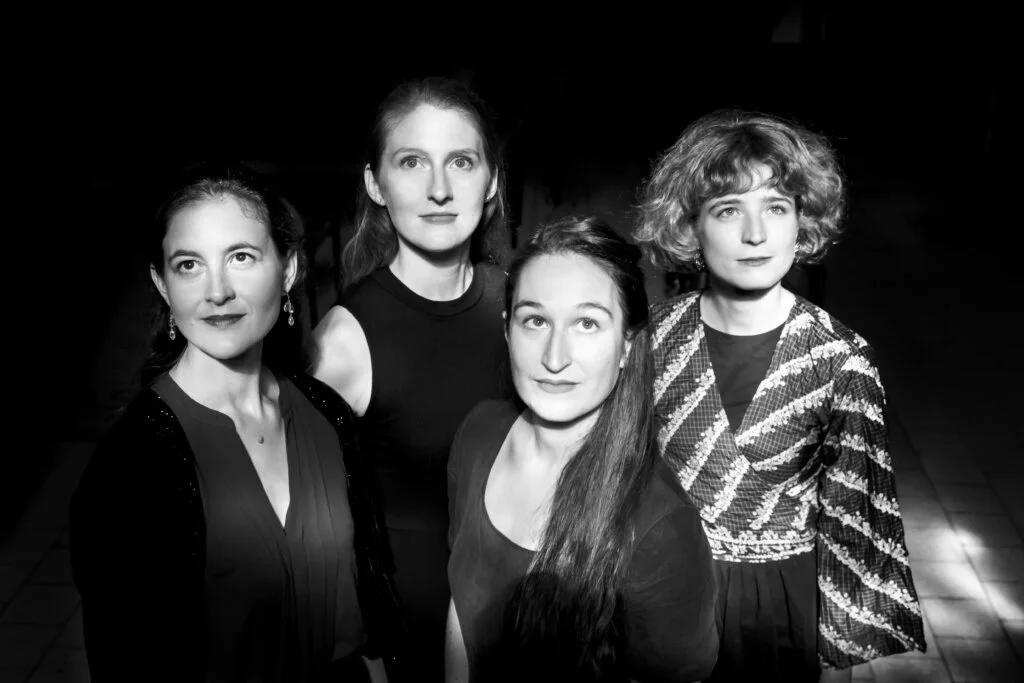
Contre le Temps
Contre le Temps est un ensemble vocal féminin spécialisé dans la musique médiévale, fondé en 2021 par Julia Marty, Cécile Walch, Karin Weston et Amy Farnell pendant leurs années de formation à la Schola Cantorum Basiliensis (Bâle). Se voulant l’interprète d’une variété de genres musicaux du XIe au XVIe siècle, l’ensemble conjugue connaissances musicologiques et sensibilité musicale personnelle.
A l’origine, ce répertoire était interprété par des communautés féminines qui se connaissaient bien et avaient l’habitude de chanter ensemble. C’est cette relation musicale et personnelle que l’ensemble cherche à retrouver, en créant un son unifié qui, cependant, respecte et célèbre l’individualité de chaque voix. D’où la singulière force émotionnelle qui se dégage de ces quatre voix féminines à l’unisson.
Contre le Temps privilégie un lent processus de recherche collective, sans directeur unique ; il essaye différents phrasés, tempos et couleurs et prend le temps d’intérioriser et de mémoriser le répertoire. Ce processus graduel contraste avec la culture actuelle de la rapidité dans le travail de restitution de la musique ancienne.
Outre ce souci de renouvellement permanent du son, l’ensemble cherche à développer une relation particulière avec le public en investissant de manière innovante l’espace scénique pour rompre avec la disposition frontale habituelle. Il s’autorise également à improviser, à la manière d’un musicien médiéval, afin de rendre les représentations plus vivantes pour le public.
Contre le Temps rayonne dans toute l’Europe, se produisant non seulement en France (Festival international de musique baroque de Beaune, Festival CavroArts en Vallée de Chevreuse) mais aussi en Belgique (Festival de Musique Ancienne de Bruges, festival Laus Polyphoniae d’Anvers), en Angleterre (Beverley Early Music Festival), aux Pays-Bas (Festival Oude Muziek d’Utrecht), et en Allemagne (série de concerts Musica Antiqua de la Radio bavaroise, festival Via Medieval).